Yoga for Health: An Introduction
Introduction
Yoga is a mind-body
practice in complementary and alternative medicine, a group of diverse medical and health care systems,
practices, and products that are not presently considered to be part of conventional medicine. Complementary
medicine is used together with conventional medicine, and alternative medicine is used in place of conventional
medicine (CAM) with origins in ancient Indian philosophy. The various styles
of yoga that people use for health purposes typically combine physical postures, breathing
techniques, and meditation. A conscious mental process using certain techniques—such as focusing attention or
maintaining a specific posture—to suspend the stream of thoughts and relax the body and mind. or relaxation.
This Backgrounder provides a general overview of yoga and suggests sources for more
information.
Key Points
- People use yoga for a variety of health conditions and to achieve fitness and relaxation.
- It is not fully known what changes occur in the body during yoga; whether they influence health; and if so,
how. There is, however, growing evidence to suggest that yoga works to enhance stress-coping mechanisms and
mind-body awareness. Research is under way to find out more about yoga's effects, and the diseases and
conditions for which it may be most helpful.
- Tell your health care providers about any complementary and alternative practices you use. Give them a full
picture of what you do to manage your health. This will help ensure coordinated and safe care.
Overview
Yoga in its full form combines physical postures, breathing exercises, meditation, and a distinct
philosophy. Yoga is intended to increase relaxation and balance the mind, body, and the spirit.
Early written descriptions of yoga are in Sanskrit, the classical language of India. The word "yoga" comes from the
Sanskrit word yuj, which means "yoke or union." It is believed that this describes the union between the mind and
the body. The first known text, The Yoga Sutras, was written more than 2,000 years ago, although yoga may have been
practiced as early as 5,000 years ago. Yoga was originally developed as a method of discipline and attitudes to
help people reach spiritual enlightenment. The Sutras outline eight limbs or foundations of yoga practice that
serve as spiritual guidelines:
- yama (moral behavior)
- niyama (healthy habits)
- asana (physical postures)
- pranayama (breathing exercises)
- pratyahara (sense withdrawal)
- dharana (concentration)
- dhyana (contemplation)
- samadhi (higher consciousness)
The numerous schools of yoga incorporate these eight limbs in varying proportions. Hatha yoga,
the most commonly practiced in the United States and Europe, emphasizes two of the eight limbs: postures (asanas)
and breathing exercises (pranayama). Some of the major styles of hatha yoga include Ananda, Anusara, Ashtanga,
Bikram, Iyengar, Kripalu, Kundalini, and Viniyoga.
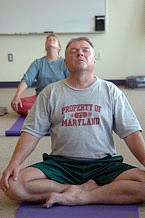
Man in yoga pose. © Bob Stockfield
Use of Yoga for Health in the United States
According to the 2007 National Health Interview Survey (NHIS), which included a comprehensive survey of CAMA group
of diverse medical and health care systems, practices, and products that are not presently considered to be part of
conventional medicine.
Complementary medicine is used together with conventional medicine, and alternative medicine is used in place of
conventional medicine. use by Americans, yoga is one of the top 10 CAM modalities used. More than 13 million adults
had used yoga in the previous year, and between the 2002 and 2007 NHIS, use of yoga among adults increased by 1
percent (or approximately 3 million people). The 2007 survey also found that more than 1.5 million children used
yoga in the previous year.
People use yoga for a variety of health conditions including anxiety disorders or stress, asthma, high
blood pressure, and depression. People also use yoga as part of a general health regimen—to achieve
physical fitness and to relax.
The Status of Yoga Research
Research suggests that yoga might:
- Improve mood and sense of well-being
- Counteract stress
- Reduce heart rate and blood pressure
- Increase lung capacity
- Improve muscle relaxation and body composition
- Help with conditions such as anxiety, depression, and insomnia
- Improve overall physical fitness, strength, and flexibility
- Positively affect levels of certain brain or blood chemicals.
More well-designed studies are needed before definitive conclusions can be drawn about yoga's use for specific
health conditions.
Side Effects and Risks
- Yoga is generally considered to be safe in healthy people when practiced appropriately. Studies have found
it to be well tolerated, with few side effects.
- People with certain medical conditions should not use some yoga practices. For example, people with disc
disease of the spine, extremely high or low blood pressure, glaucoma, retinal detachment, fragile or
atherosclerotic arteries, a risk of blood clots, ear problems, severe osteoporosis, or cervical spondylitis
should avoid some inverted poses.
- Although yoga during pregnancy is safe if practiced under expert guidance, pregnant women should avoid
certain poses that may be problematic.
Training, Licensing, and Certification
There are many training programs for yoga teachers throughout the country. These programs range from a few days to
more than 2 years. Standards for teacher training and certification differ depending on the style of yoga.
There are organizations that register yoga teachers and training programs that have complied with minimum
educational standards. For example, one nonprofit group requires at least 200 hours of training, with a specified
number of hours in areas including techniques, teaching methodology, anatomy, physiology, and philosophy. However,
there are currently no official or well-accepted licensing requirements for yoga teachers in the United States.
If You Are Thinking About Yoga
- Do not use yoga as a replacement for conventional care or to postpone seeing a doctor about a medical
problem.
- If you have a medical condition, consult with your health care provider before starting yoga.
- Ask about the physical demands of the type of yoga in which you are interested, as well as the training and
experience of the yoga teacher you are considering.
- Look for published research studies on yoga for the health condition you are interested in.
- Tell your health care providers about any complementary and alternative practices you use. Give them a full
picture of what you do to manage your health. This will help ensure coordinated and safe care. For tips about
talking with your health care providers about CAM, see NCCAM's Time to Talk campaign.
NCCAM-Funded Research
Recent studies supported by NCCAM have been investigating yoga's effects on:
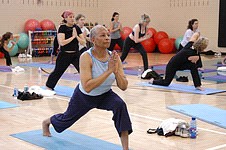
Women in yoga class
Courtesy of National Institute on Aging
- Blood pressure
- Chronic low-back pain
- Chronic obstructive pulmonary disease
- Depression
- Diabetes risk
- HIV
- Immune function
- Inflammatory arthritis and knee osteoarthritis
- Insomnia
- Multiple sclerosis
- Smoking cessation
References
- Bower JE, Woolery A, Sternlieb B, et al.
Yoga for cancer patients and survivors. Cancer
Control. 2005;12(3):165–171.
- Khalsa SBS. Yoga as a therapeutic
intervention: a bibliometric analysis of published research studies. Indian Journal of Physiology and Pharmacology. 2004;48(3):269–285.
- Lipton L. Using yoga to treat disease: an
evidence-based review. Journal of the
American Academy of Physican
Assistants. 2008;21(2):34–41.
- Oken BS, Zajdel D, Kishiyama S, et al.
Randomized, controlled, six-month trial of yoga in healthy seniors: effects on cognition and quality of
life. Alternative Therapies in Health and
Medicine. 2006;12(1):40–47.
- Raub, JA. Psychophysiologic effects of hatha
yoga on musculoskeletal and cardiopulmonary function: a literature review. The Journal of Alternative and Complementary Medicine. 2002;8(6):797–812.
- Sherman K, Cherkin D, Erro J, et al.
Comparing yoga, exercise, and a self-care book for chronic low back pain. Annals of Internal Medicine.
2005;143(12):849–856.
- Williams KA, Petronis J, Smith D, et al.
Effect of Iyengar yoga therapy for chronic low back pain. Pain.
2005;115(1–2):107–117.
|